
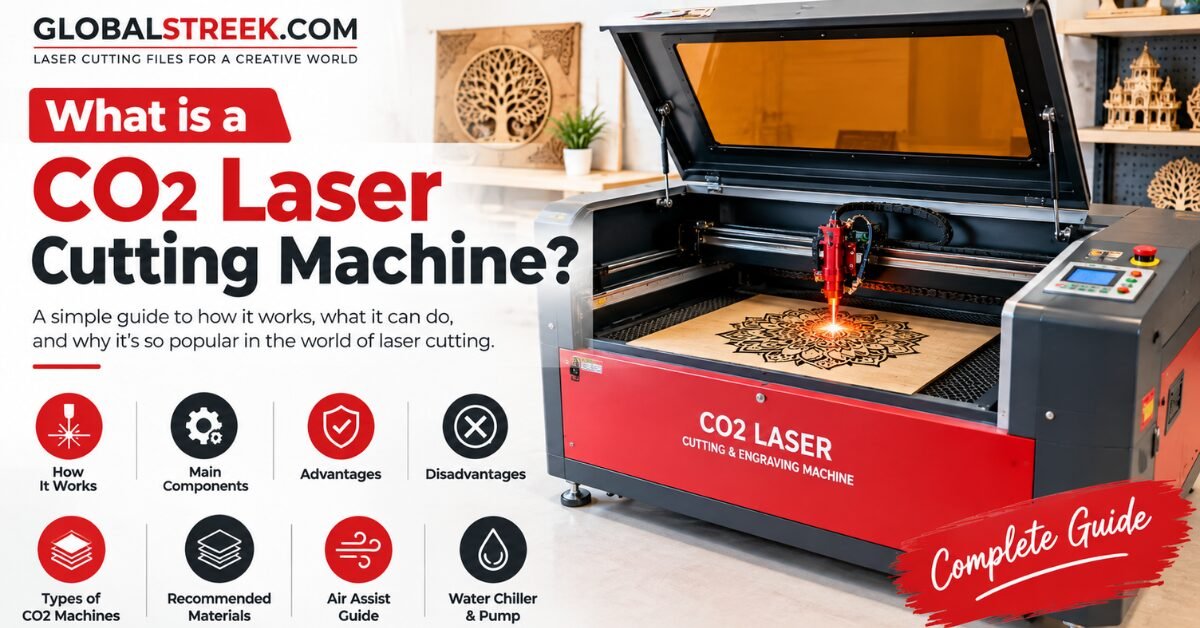
How Does a CO2 Laser Cutting Machine Work?
Most people know that a CO2 laser cutting machine can cut materials such as wood, acrylic, MDF, leather, paper, and many other non-metal materials. However, very few people understand what actually happens inside the machine after the Start button is pressed.
A CO2 laser cutting machine is a combination of mechanical, electrical, optical, electronic, cooling, and software systems. Every component has a specific function, and all of these components work together to generate, guide, focus, and control the laser beam.
Instead of looking at the machine only from the outside, let’s take a closer look at what happens inside a CO2 laser cutting machine and understand how the complete system works.
For a complete explanation, read our guide: How Does a CO2 Laser Cutting Machine Work?
How Is a CO2 Laser Tube Made?
The CO2 laser tube is one of the most important components of a CO2 laser cutting machine. In many desktop and mid-range machines, the tube is made from specially designed glass. Industrial CO2 laser systems may use metal or other specialized laser sources.
Inside a sealed CO2 laser tube is a carefully controlled gas mixture. The primary gases are:
- Carbon dioxide (CO₂)
- Nitrogen (N₂)
- Helium (He)
Depending on the tube design and manufacturer, very small quantities of other gases may also be used to improve the operating characteristics, stability, or efficiency of the laser.
The exact gas composition, tube construction, electrode design, cooling system, and manufacturing quality can all affect the performance and lifespan of a CO2 laser tube.
The gases are sealed inside the tube during manufacturing, so the operator does not normally need to refill them during regular use.
How Does the Laser Beam Form Inside the Tube?
The laser-generation process begins when the laser power supply provides high voltage to the CO2 laser tube.
The basic process works as follows:
- High voltage is applied to the laser tube.
The laser power supply creates an electrical discharge through the gas mixture inside the tube. - The gas molecules become excited.
The electrical discharge transfers energy to the gas molecules. Nitrogen plays an important role in transferring energy to the carbon dioxide molecules. - Energy is transferred to carbon dioxide molecules.
The excited nitrogen molecules transfer energy to CO₂ molecules, placing them into an excited energy state. - Carbon dioxide produces infrared radiation.
When the excited CO₂ molecules return to a lower energy state, they emit infrared radiation. The main wavelength used by typical CO₂ lasers is approximately 10.6 micrometers (µm). - The light is amplified inside the resonator.
The generated light travels back and forth between reflective surfaces at the ends of the laser tube. This process amplifies the light and produces a coherent laser beam. - A small portion of the beam exits the tube.
One end of the laser resonator acts as the output coupler, allowing part of the laser energy to leave the tube.
This exiting beam becomes the laser beam that is guided through the machine’s optical system.
What Happens After the Beam Leaves the Laser Tube?
The laser beam does not normally travel directly from the tube to the material.
Instead, it is guided through a series of optical components.
In many common CO2 laser cutting machines:
- The beam leaves the laser tube.
- It reaches the first external mirror.
- The first mirror redirects the beam toward the next section of the machine.
- The beam travels to the second mirror.
- The second mirror redirects the beam toward the laser head.
- A third mirror is commonly used to direct the beam downward into the focusing assembly.
- The focusing lens then concentrates the beam onto the material.
The mirrors are carefully aligned so that the laser beam reaches the focusing lens at the correct position and angle.
Even a small alignment error can affect cutting quality, especially across a large working area.
Why Is the Focusing Lens So Important?
The focusing lens is one of the most critical optical components in a CO2 laser cutting machine.
Without proper focusing, the laser beam would remain relatively broad when it reaches the material. This would reduce the energy density and make precise cutting much more difficult.
The focusing lens concentrates the laser beam into a very small focal spot.
At the focal point, the energy density becomes extremely high. Depending on the material and machine settings, the concentrated laser energy can:
- Melt the material
- Burn the material
- Vaporize the material
- Remove material through rapid heating
The exact spot size depends on several factors, including the lens focal length, beam quality, optical alignment, and laser characteristics.
A dirty, damaged, or incorrectly installed lens can significantly reduce cutting performance. For this reason, the focusing lens should be inspected and cleaned according to the machine manufacturer’s recommendations.
For a complete explanation, read our guide: Advantages of CO2 Laser Machines
How Does the Machine Know Where to Cut?
A CO2 laser cutting machine follows digital instructions generated from a design file.
The process generally looks like this:
Design → Software → Machine Instructions → Controller → Motors + Laser
First, the design is created or prepared using software such as:
- CorelDRAW
- AutoCAD
- LightBurn
- RDWorks
- LaserCAD
- Adobe Illustrator
- Inkscape
The software converts the design into machine-readable movement and laser-control instructions.
These instructions are then sent to the machine controller.
The controller determines:
- Where the laser head should move
- How fast it should move
- When the laser should fire
- When the laser should stop firing
- How acceleration and deceleration should be handled
- How the machine should respond to switches and other inputs
The controller processes these commands continuously while the machine is operating.
For a complete explanation, read our guide: Types of CO2 Laser Cutting Machines
What Does the CO2 Laser Controller Board Do?
The controller board can be considered the central control system of many CO2 laser machines.
It receives instructions from the computer or software and coordinates the machine’s movement and laser operation.
Depending on the controller and machine configuration, it may control or monitor functions such as:
- X-axis movement
- Y-axis movement
- Laser firing
- Motor speed
- Acceleration and deceleration
- Home position
- Limit switches
- Job execution
- Emergency-stop inputs
- Machine status
- Communication with the computer
Common controller brands found in CO2 laser machines include Ruida, Trocen, TopWisdom, and Leetro. The exact features and software compatibility depend on the controller model.
Industrial laser machines may use more advanced or proprietary control systems designed specifically for the machine.
For a complete explanation, read our guide: Disadvantages of CO2 Laser Machines
How Do the Motors Move the Laser Head?
The laser head needs to move accurately across the working area while following the design.
Many CO2 laser machines use stepper motors, while higher-end industrial machines may use servo motors.
The basic motion process is:
- The controller sends electrical signals to the motor driver.
- The motor driver supplies the appropriate electrical current to the motor.
- The motor rotates according to the commands received.
- A mechanical transmission system transfers this rotation into linear movement.
- The laser head moves along the X or Y axis.
Depending on the machine design, movement may be transferred using timing belts, lead screws, rack-and-pinion systems, or other mechanical mechanisms.
In belt-driven CO2 laser machines, timing belts are commonly used because they allow fast movement while maintaining good positioning accuracy.
The controller continuously coordinates the X and Y movements so the laser head can follow curves, lines, circles, and complex designs.
Why Is Water Cooling Necessary?
CO2 laser tubes generate considerable heat during operation. Proper cooling is therefore essential for stable operation.
In many glass-tube CO2 laser machines, water is circulated through the cooling jacket surrounding the laser tube.
The cooling system helps:
- Remove heat from the laser tube
- Maintain a suitable operating temperature
- Prevent excessive thermal stress
- Maintain more consistent laser output
- Extend the useful life of the tube
Smaller machines may use a water pump and reservoir, while more advanced machines commonly use a dedicated water chiller.
A chiller can maintain the coolant temperature more consistently than a basic water circulation system, which is especially useful during long production jobs.
The correct coolant temperature and cooling method should always follow the laser tube and machine manufacturer’s specifications.
What Is Air Assist?
Air assist is an important part of a CO2 laser cutting system. It directs a controlled stream of air toward the cutting point through a nozzle near the focusing lens.
Air assist performs several important functions:
- Helps remove smoke and fumes from the cutting area
- Reduces charring and excessive burning
- Helps clear debris from the cut
- Helps protect the focusing lens from smoke and particles
- Improves the appearance of many cut edges
- Helps reduce the chance of small flames during cutting
The amount of air pressure required depends on the material, thickness, nozzle design, and cutting application.
For example, cutting wood or MDF may require different air-assist settings than engraving acrylic or other materials.
How Many Main Components Does a CO2 Laser Machine Have?
The exact configuration varies between manufacturers and machine types. However, a typical CO2 laser cutting machine can contain the following major components:
- CO2 Laser Tube
- Laser Power Supply
- Reflective Mirrors
- Focusing Lens
- Laser Head
- X-Axis Assembly
- Y-Axis Assembly
- Stepper or Servo Motors
- Motor Drivers
- Controller Board
- Water Cooling System
- Air Assist Compressor
- Exhaust Fan
- Honeycomb or Blade Cutting Table
- Limit Switches
- Timing Belts or Other Transmission Systems
- Linear Guide Rails
- Power Distribution System
- Emergency Stop Circuit
- Computer Communication Interface
Some machines may include additional components such as:
- Rotary attachments
- Automatic focus systems
- Motorized tables
- Ruida or other DSP controllers
- Water-flow protection
- Temperature sensors
- Door safety switches
- Air-pressure sensors
- Automatic lubrication systems
- Red-dot laser pointers
- Different exhaust configurations
The more advanced the machine, the more monitoring and automation systems it may include.
For a complete explanation, read our guide: CO2 Laser Machine Parts Explained
How Do All These Components Work Together?
A CO2 laser cutting machine works because all of these systems operate together.
The complete process can be simplified into the following sequence:
1. Design Preparation
A design is created or imported into compatible software.
2. Machine Settings
The operator selects parameters such as speed, power, and cutting settings.
3. Job Transfer
The software sends the required instructions to the machine controller.
4. Motion Control
The controller commands the X and Y motors to move the laser head according to the design.
5. Laser Generation
The laser power supply activates the CO2 laser tube, producing the laser beam.
6. Beam Delivery
The beam travels through the machine’s mirror system.
7. Beam Focusing
The focusing lens concentrates the beam onto the material.
8. Material Processing
The concentrated laser energy cuts, engraves, or marks the material.
9. Air Assist and Exhaust
Air assist helps control the cutting area, while the exhaust system removes smoke and fumes.
10. Cooling
The cooling system keeps the laser tube within its required operating temperature range.
All of these processes happen together while the controller continuously manages the machine’s movement and laser operation.
Final Thoughts
A CO2 laser cutting machine is much more than a simple cutting tool. It is an integrated system that combines laser physics, gas discharge, optics, electronics, motion control, cooling, air assist, exhaust, and software.
From the moment a digital design is sent to the machine until the laser beam reaches the material, multiple components work together with precise coordination.
Understanding how these internal systems work can help you operate a CO2 laser machine more effectively. It can also make it easier to identify common problems related to laser power, mirror alignment, focusing, cooling, air assist, motor movement, controller settings, and cutting quality.
Once you understand what happens inside the machine, troubleshooting becomes much easier because you can identify which part of the system may be responsible for a particular problem.