
Introduction
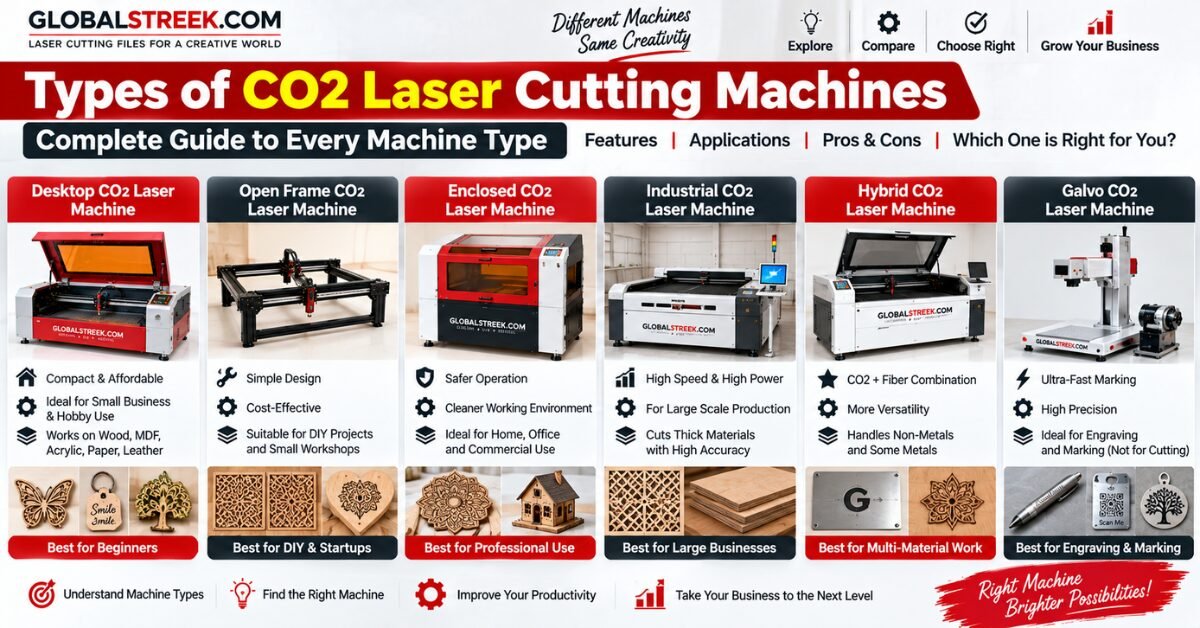
CO2 laser cutting machines come in different sizes, configurations, laser powers, and mechanical designs. Although they use the same basic CO2 laser technology, manufacturers build different machine types for specific materials, production volumes, applications, and budgets.
For example, a small desktop laser may suit a hobbyist or a home-based business, while a large industrial CO2 laser machine can handle continuous production and larger sheets.
Choosing the right type of CO2 laser machine depends on several factors, including the materials you want to process, required cutting area, production volume, available workspace, laser power, and budget.
This guide explains the main types of CO2 laser cutting machines and how their different configurations affect real-world applications.
1. Desktop CO2 Laser Cutting Machine
A desktop CO2 laser cutting machine is one of the most compact options available. Manufacturers typically design these machines for beginners, hobbyists, educational institutions, small workshops, and businesses with relatively light production requirements.
Best For
- Learning laser cutting and engraving
- Hobby projects
- Personalized gifts
- Small craft businesses
- Small acrylic products
- Educational projects
- Light-duty engraving
Advantages
- Compact design
- Lower initial investment
- Easier installation
- Requires less workspace
- Suitable for small-scale production
Limitations
- Smaller working area
- Usually lower laser power
- Limited production capacity
- Not ideal for high-volume manufacturing
A desktop CO2 laser can be a practical starting point for users who want to learn the technology without investing in a large industrial machine.
2. Benchtop CO2 Laser Cutting Machine
A benchtop CO2 laser machine generally provides more working space and capability than a compact desktop model while still maintaining a relatively small footprint.
Small businesses often choose this type when they need more production capacity but do not require a large industrial system.
Common Applications
- Trophy production
- Name plates
- Personalized gifts
- Leather products
- MDF crafts
- Acrylic signage
- Small-batch production
Advantages
- More working space than many desktop models
- Suitable for small businesses
- Relatively compact
- Good balance between size and production capability
The exact distinction between “desktop” and “benchtop” varies between manufacturers, so always compare the actual working area, laser power, and machine specifications rather than relying only on the product category.
3. Industrial CO2 Laser Cutting Machine
Industrial CO2 laser machines are designed for demanding production environments. They generally use stronger mechanical structures, more robust motion systems, larger working areas, and higher-power laser sources than small workshop machines.
Depending on the machine, industrial systems may also include advanced controllers, automatic focusing, motorized tables, improved cooling, and automated material-handling options.
Best For
- Furniture manufacturing
- Sign manufacturing
- Packaging
- Commercial laser cutting
- Large production workshops
- Industrial fabrication
Advantages
- High production capacity
- Larger working areas
- Robust mechanical construction
- Suitable for longer operating periods
- Greater automation options
- Consistent production performance
Industrial machines require a larger investment and usually need more space, power, ventilation, cooling, and infrastructure.
4. Large-Format CO2 Laser Cutting Machine
A large-format CO2 laser cutting machine provides a larger working area for processing oversized sheets.
This configuration can reduce the need to divide large sheets into smaller sections before cutting.
Common Materials
Depending on the machine specifications, large-format CO2 lasers can process materials such as:
- MDF
- Plywood
- Acrylic
- Wood
- Fabric
- Leather
- Paper and cardboard
Common Industries
- Furniture manufacturing
- Interior decoration
- Architectural panels
- Advertising
- Sign manufacturing
- Large decorative products
The required working area should match the maximum sheet size you regularly use. Buying a larger machine than necessary can increase the initial and operating costs without providing a practical benefit.
5. Single-Head CO2 Laser Machine
A single-head CO2 laser machine uses one laser head for cutting and engraving.
This is one of the most common configurations for small and medium-sized businesses because it offers a straightforward mechanical and optical setup.
Advantages
- Simpler design
- Lower equipment cost in many cases
- Easier maintenance
- Straightforward operation
- Suitable for general-purpose cutting and engraving
A single-head machine can handle a wide variety of jobs, making it suitable for businesses that frequently change between different products and designs.
6. Dual-Head CO2 Laser Machine
A dual-head CO2 laser machine uses two laser heads. Depending on the machine design, the heads may work from the same laser source or use a configuration that allows specific production workflows.
Dual-head systems can improve productivity when the machine repeatedly produces identical or compatible designs.
Best For
- High-volume production
- Promotional products
- MDF crafts
- Personalized products
- Repeated components
- Batch manufacturing
Important Consideration
A dual-head machine does not automatically double production speed.
The actual productivity gain depends on the machine’s optical design, controller, laser source, head arrangement, material, design, and production workflow.
If your business mainly produces different designs one at a time, a single-head machine may offer a simpler workflow.
7. Mixed or Hybrid CO2 Laser Cutting Machine
Some machines combine a CO2 laser system with additional cutting capabilities. These machines may process non-metal materials with the CO2 laser while using another technology or tool for specific materials.
The exact capabilities vary significantly between manufacturers.
Common Applications
- Sign manufacturing
- Advertising products
- Mixed-material fabrication
- Production environments requiring different cutting processes
Before purchasing a mixed or hybrid machine, check exactly which materials each cutting system supports. Do not assume that every hybrid machine can perform heavy metal cutting.
8. Flatbed CO2 Laser Cutting Machine
A flatbed CO2 laser machine uses a horizontal working table to support the material.
The material generally remains stationary while the laser head moves across the working area.
This design is extremely common for cutting and engraving:
- Wood
- MDF
- Acrylic
- Plywood
- Leather
- Paper
- Cardboard
- Fabric
Advantages
- Stable material support
- Suitable for sheet materials
- Precise cutting
- Flexible for cutting and engraving
- Simple material loading
Flatbed systems are a practical choice for general-purpose CO2 laser applications.
9. Flying-Optics CO2 Laser Machine
In a flying-optics laser system, the workpiece generally remains stationary while the laser beam delivery system moves across the work area.
The moving optics and laser head allow the machine to process large areas quickly while maintaining the required beam path.
Best For
- High-speed cutting
- Large production runs
- Industrial manufacturing
- Large-format applications
The term “flying optics” describes the optical and motion arrangement rather than simply referring to a high-power machine. Performance still depends on the laser source, motion system, optics, controller, and machine construction.
Types of CO2 Laser Machines Based on Cooling
CO2 laser machines can also be classified according to their cooling system.
Water-Cooled CO2 Laser Machine
Water cooling is common in glass-tube CO2 laser machines.
A pump or chiller circulates water through the laser tube to remove heat and maintain the operating temperature within the required range.
Water-cooled systems are particularly common in medium- and high-power CO2 laser machines.
Advantages
- Effective heat removal
- Suitable for higher-power tubes
- Stable operating temperature
- Suitable for longer production periods
A dedicated water chiller provides more precise temperature control than a simple water reservoir and pump.
Air-Cooled CO2 Laser Machine
Some lower-power CO2 laser systems use air cooling.
These machines are generally designed for lighter-duty applications where the laser source does not generate as much heat as a larger glass or industrial CO2 tube.
Suitable For
- Small machines
- Light-duty engraving
- Compact applications
- Some low-power systems
The cooling method should always match the laser source’s specifications.
Types of CO2 Laser Machines Based on Motion System
The motion system has a major effect on machine speed, positioning, accuracy, and maintenance.
Stepper Motor CO2 Laser Machine
Stepper motors are widely used in entry-level and mid-range CO2 laser machines.
The controller sends pulses to the motor driver, which moves the motor in controlled steps.
Advantages
- Lower cost
- Simple control
- Reliable for many applications
- Suitable for small and medium machines
Stepper systems can provide excellent results when the machine has a good mechanical design and proper calibration.
Servo Motor CO2 Laser Machine
Servo motors use feedback to control position and movement more precisely.
Industrial CO2 laser machines may use servo systems when the application requires high-speed movement, precise positioning, and demanding production performance.
Advantages
- High-speed movement
- Precise positioning
- Closed-loop feedback
- Suitable for demanding industrial applications
Servo systems usually cost more than basic stepper systems, so the additional performance should match the production requirements.
Types of CO2 Laser Machines Based on Laser Power
Another common way to classify CO2 laser machines is by laser tube power.
40W–60W CO2 Laser Machines
These machines are commonly used for:
- Engraving
- Paper
- Leather
- Fabric
- Thin wood
- Light-duty cutting
The actual cutting capability depends on the material and machine configuration.
80W–100W CO2 Laser Machines
This range is popular among small and medium businesses because it offers a useful balance between cutting capability and operating cost.
Typical applications include:
- MDF cutting
- Acrylic cutting
- Plywood cutting
- Wooden products
- Signage
- Personalized products
- Commercial crafts
130W–150W CO2 Laser Machines
Higher-power CO2 laser machines can provide faster cutting and greater cutting capacity for suitable non-metal materials.
They are commonly considered for:
- Higher production volumes
- Thicker materials
- Large-format cutting
- Commercial manufacturing
Higher wattage does not automatically mean better overall performance. The laser power should match the material thickness, required speed, working area, optics, cooling system, and production requirements.
CO2 Laser Machine Types at a Glance
| Machine Type | Typical Use | Main Benefit |
|---|
| Desktop | Hobby, learning, small products | Compact size |
| Benchtop | Small business | More workspace |
| Industrial | Commercial production | High productivity |
| Large Format | Large sheets | Handles oversized materials |
| Single Head | General production | Simple operation |
| Dual Head | Repeated batch production | Potentially higher throughput |
| Flatbed | Sheet cutting and engraving | Stable material support |
| Flying Optics | High-speed production | Fast beam delivery |
| Water Cooled | Medium/high power | Effective heat removal |
| Air Cooled | Low-power systems | Compact cooling |
| Stepper Motor | Entry/mid-range machines | Cost-effective motion |
| Servo Motor | Industrial machines | High-speed precision |
Which Type of CO2 Laser Machine Should You Choose?
The right CO2 laser cutting machine depends on your application rather than simply the machine’s wattage.
For Beginners and Hobby Users
A desktop or small benchtop CO2 laser machine can provide a practical starting point for learning and small projects.
For Small Businesses
A benchtop or medium-size flatbed machine can provide a useful balance between working area, investment, and production capacity.
For Daily Commercial Production
An industrial CO2 laser machine with a robust motion system, suitable cooling, reliable controller, and adequate laser power can support higher production requirements.
For Large Sheets
Choose a large-format machine if your regular materials exceed the working area of smaller machines.
For Repeated Batch Production
A dual-head configuration may improve productivity when the production workflow involves repeated or identical designs.
For High-Speed Industrial Applications
A machine with a servo-based motion system may be appropriate when the production process requires high speed and precise positioning.
What Should You Check Before Buying a CO2 Laser Machine?
Before purchasing a machine, consider more than just the advertised wattage.
Check:
- Laser power
- Working area
- Laser tube type
- Controller
- Motion system
- Stepper or servo motors
- Mirror and lens quality
- Cooling system
- Air assist
- Exhaust system
- Machine frame
- Guide rails
- Maximum material thickness
- Software compatibility
- Electrical requirements
- Availability of spare parts
- After-sales service
- Warranty
- Maintenance requirements
- Total operating cost
The best machine is not necessarily the one with the highest wattage. It is the one that matches your material, production volume, working area, budget, and workflow.
Conclusion
CO2 laser cutting machines come in many configurations because different users have different production requirements.
You can choose between desktop, benchtop, industrial, large-format, single-head, dual-head, flatbed, and other specialized configurations. You can also compare machines based on their cooling systems, motion technology, and laser power.
Understanding these differences can help you avoid buying a machine that is either too small for your production needs or unnecessarily large and expensive for your application.
Before making a purchase, focus on the complete machine rather than looking at wattage alone. Consider the laser source, working area, controller, motion system, cooling, optics, exhaust, software, maintenance, and after-sales support.
A properly matched CO2 laser machine can provide the right balance of cutting performance, production speed, accuracy, and operating cost for your specific application.
Frequently Asked Questions
Q1. Which type of CO2 laser machine is best for beginners?
A desktop or benchtop CO2 laser machine can be a suitable starting point for beginners because these machines generally require less space and support smaller-scale applications.
Q2. What is the difference between a desktop and an industrial CO2 laser machine?
Industrial machines generally offer larger working areas, stronger mechanical construction, higher production capacity, and more advanced motion and control systems. Desktop machines focus more on compact size and lighter workloads.
Q3. Is a dual-head CO2 laser machine worth buying?
A dual-head machine can make sense when your production involves repeated or identical designs. However, the actual productivity improvement depends on the machine’s design and workflow.
Q4. Which cooling system is better for a CO2 laser machine?
For medium- and high-power glass CO2 laser tubes, water cooling is widely used. Low-power compact systems may use air cooling. The correct choice depends on the laser source and manufacturer’s specifications.
Q5. Does a higher-wattage CO2 laser machine always perform better?
No. Higher wattage can provide greater cutting capacity and faster processing for suitable materials, but overall performance also depends on the optics, focus, motion system, cooling, air assist, controller, and machine construction.
Q6. What is the difference between a flatbed and flying-optics CO2 laser?
A flatbed machine describes the worktable and material-support arrangement, while flying optics describes a system where the optical delivery moves across the work area. These terms can describe overlapping machine designs rather than completely separate machine categories.
Q7. Which CO2 laser power is suitable for MDF?
The required power depends on MDF thickness, density, cutting speed, number of passes, lens, air assist, and machine configuration. For commercial cutting, 80W–100W and higher-power machines are commonly considered, but actual settings should always come from material testing.
Q8. Can a CO2 laser machine cut acrylic?
Yes. CO2 lasers are widely used to cut and engrave many types of laser-compatible acrylic. The required laser power and settings depend on the acrylic thickness, type, and desired cutting speed.
Q9. Can a CO2 laser machine cut metal?
Typical CO2 machines designed for wood, MDF, acrylic, and similar materials are not intended for general-purpose metal cutting. Specialized industrial CO2 systems can process certain metals, but they use different configurations and requirements.
Q10. What is the most important factor when choosing a CO2 laser machine?
The most important factor is matching the machine to your actual application. Consider the material, thickness, working area, production volume, required speed, laser power, machine configuration, budget, and long-term maintenance requirements.
Text
Text