
Introduction
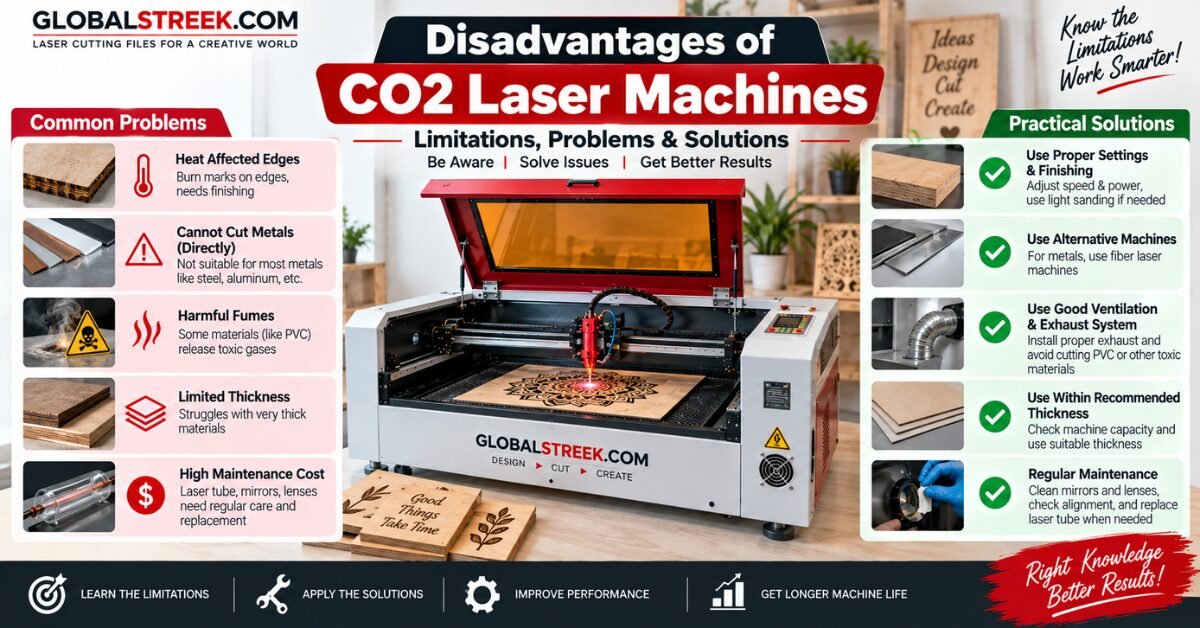
A CO2 laser machine is widely used for cutting and engraving non-metal materials such as wood, MDF, acrylic, plywood, leather, paper, and fabric. It offers high precision, repeatable results, and efficient production. However, like any manufacturing machine, a CO2 laser also has certain limitations.
Understanding the disadvantages of CO2 laser machines before purchasing or operating one can help you choose the right machine, estimate operating costs, and avoid common problems.
Most of these challenges are manageable with proper machine selection, regular maintenance, correct operating settings, effective cooling, and suitable ventilation.
This guide explains the most common CO2 laser machine disadvantages, why they occur, how they affect production, and what you can do to reduce their impact.
1. Limited Metal Cutting Capability
Why Does This Happen?
Standard CO2 laser machines used for woodworking, acrylic, MDF, and similar applications are primarily designed for non-metal materials.
CO2 lasers operate at a wavelength of approximately 10.6 micrometers. Many common metals reflect a significant portion of this infrared wavelength, making them difficult to process with a typical CO2 laser setup.
Specialized industrial CO2 laser systems can process certain metals under specific conditions, but they differ significantly from the CO2 machines commonly used by small businesses and workshops.
Impact
If your primary requirement is cutting:
- Mild steel
- Stainless steel
- Aluminum
- Brass
- Copper
a standard non-metal CO2 laser machine may not be the right choice.
Possible Solution
Choose the laser technology according to your primary material.
For wood, MDF, acrylic, leather, paper, and similar materials, a CO2 laser can be suitable. For many metal-cutting applications, businesses commonly consider fiber laser machines designed specifically for metal processing.
2. Laser Tube Has a Limited Service Life
Why Does This Happen?
Many CO2 machines use glass laser tubes that gradually lose performance over time.
Factors such as:
- Operating hours
- Laser power
- Cooling temperature
- Operating conditions
- Tube quality
- Maintenance
can affect tube performance and service life.
Impact
As the tube’s output decreases, you may notice:
- Slower cutting
- Difficulty cutting thicker materials
- More passes required
- Inconsistent cutting performance
- Longer production times
Eventually, the tube requires replacement.
Possible Solution
Maintain the cooling system properly, operate the tube within the manufacturer’s recommended limits, and avoid unnecessarily high power for extended periods.
3. Cooling System Requires Regular Attention
Why Does This Happen?
A CO2 laser tube generates heat during operation. Glass laser tubes commonly require water cooling to keep their operating temperature within the recommended range.
Impact
Poor cooling can cause:
- Unstable laser output
- Reduced cutting performance
- Increased tube wear
- Overheating
- Unexpected downtime
Possible Solution
Use an appropriate cooling system for your machine. Depending on the setup, this may include a water pump, reservoir, or dedicated water chiller.
Regularly check:
- Coolant temperature
- Water level
- Water flow
- Tubing
- Pump or chiller operation
Always follow the laser tube and chiller manufacturer’s specifications.
4. Mirrors and Lenses Need Regular Cleaning
Why Does This Happen?
Laser cutting produces smoke, dust, vapor, and residue. Some of these contaminants can settle on the mirrors and focusing lens.
Impact
Dirty optical components can reduce the amount of laser energy reaching the material.
You may notice:
- Weak cutting
- Incomplete cuts
- Poor engraving quality
- Uneven cutting performance
- Excessive heating around the lens
Possible Solution
Inspect the optical components regularly and clean them using products and procedures recommended for laser optics.
Avoid touching optical surfaces with bare fingers, and replace damaged optics when necessary.
5. Some Materials Are Unsafe to Laser Cut
Why Does This Happen?
Not every material is suitable for laser processing. Certain plastics and manufactured materials can release toxic, corrosive, or otherwise hazardous fumes when heated by a laser.
For example, PVC and vinyl should not be processed with a CO2 laser because they can release dangerous chlorine-containing gases that may harm people and corrode machine components.
Impact
Using an unsuitable material can:
- Create hazardous fumes
- Damage optics and machine components
- Corrode metal parts
- Create fire risks
- Expose the operator to harmful substances
Possible Solution
Always verify the material before processing it.
Check the manufacturer’s material safety information and follow the laser machine manufacturer’s recommendations.
Never assume that a material is safe simply because it looks similar to another material that you have successfully cut.
6. An Effective Exhaust System Is Essential
Why Does This Happen?
Laser cutting and engraving can generate smoke, fumes, odors, and fine particles.
Impact
Poor extraction can result in:
- Smoke remaining inside the machine
- Unpleasant odors
- Poor visibility
- Residue buildup
- Contamination of optical components
- Poorer working conditions
Possible Solution
Use an appropriately sized laser exhaust system that removes fumes effectively from the machine enclosure.
Depending on the application, you may also need a suitable filtration system rather than simply exhausting fumes into an occupied area.
7. Initial Investment Can Be Significant
Why Does This Happen?
The cost of a CO2 laser machine extends beyond the machine itself.
A complete setup may require:
- CO2 laser machine
- Laser tube
- Laser power supply
- Water cooling system
- Air compressor
- Exhaust system
- Electrical installation
- Software
- Spare parts
- Installation and setup
Impact
The total initial investment can be significant, particularly for a small business or first-time buyer.
Possible Solution
Calculate the complete setup cost before purchasing.
Consider:
- Expected production volume
- Product selling price
- Material cost
- Machine operating cost
- Maintenance cost
- Expected machine utilization
- Customer demand
A realistic cost and revenue calculation gives you a better understanding of the potential return on your investment.
8. Electricity and Operating Costs
Why Does This Happen?
A CO2 laser system uses electricity for more than just the laser tube.
Depending on the machine, electricity powers:
- Laser power supply
- Motors
- Water pump or chiller
- Exhaust fan
- Air compressor
- Controller
- Cooling fans
- Other electrical components
Impact
Long production hours increase electricity consumption and overall operating costs.
Possible Solution
Use a machine with a power level and working area that match your actual production requirements.
Regular maintenance can also help keep supporting equipment operating efficiently. Avoid leaving the laser, exhaust, compressor, or other equipment running unnecessarily.
9. Cutting Precision Depends on Proper Setup
Why Does This Happen?
A CO2 laser machine can produce highly accurate results, but accuracy depends on correct machine setup and maintenance.
Important factors include:
- Mirror alignment
- Lens condition
- Focus distance
- Belt tension
- Guide rail condition
- Mechanical alignment
- Motor settings
- Controller configuration
Impact
Incorrect setup can cause:
- Rough edges
- Incomplete cuts
- Uneven engraving
- Misaligned designs
- Different cutting results across the working area
Possible Solution
Check the optical path, focus, mechanical components, and machine calibration whenever cutting quality changes.
Regular maintenance helps prevent small alignment problems from becoming larger production issues.
10. Operator Training Is Necessary
Why Does This Happen?
Modern CO2 laser machines can be relatively easy to operate, but users still need to understand the software, machine settings, materials, maintenance, and safety procedures.
Impact
An inexperienced operator may:
- Select incorrect power or speed
- Damage materials
- Produce inconsistent results
- Misalign the optics
- Ignore cooling problems
- Use unsafe materials
- Increase material waste
Possible Solution
Provide basic training before allowing an operator to run the machine independently.
It is also useful to maintain a record of tested settings for commonly used materials and thicknesses.
11. Fire Risk During Laser Cutting
Why Does This Happen?
A laser concentrates a large amount of energy into a small area. Materials such as wood, paper, cardboard, and fabric can ignite if the machine uses unsuitable settings or the beam remains in one area for too long.
Impact
A small flame can damage the material. In a serious situation, it can damage the machine or create a larger fire hazard.
Possible Solution
Never leave a CO2 laser machine unattended while it is operating.
You should also:
- Use appropriate air assist
- Keep the cutting bed clean
- Remove combustible waste
- Maintain the exhaust system
- Check the machine regularly during operation
- Keep suitable fire-safety equipment nearby
Follow local fire-safety requirements and the machine manufacturer’s recommendations.
12. Supporting Equipment Can Produce Noise
Why Does This Happen?
The laser process itself may not produce significant noise, but supporting equipment can.
Common sources include:
- Air compressor
- Exhaust fan
- Water chiller
- Cooling fans
- Motors
Impact
Noise can become noticeable during long production periods, particularly in small workshops or enclosed workspaces.
Possible Solution
Where practical, position noisy supporting equipment away from the main working area.
Regular maintenance can also reduce unnecessary vibration and noise caused by worn or loose components.
13. Regular Maintenance Takes Time
Why Does This Happen?
A CO2 laser machine contains several systems that require periodic inspection and maintenance.
Maintenance may include:
- Cleaning mirrors
- Cleaning the focusing lens
- Checking laser alignment
- Inspecting belts
- Checking guide rails
- Inspecting wiring
- Checking cooling water
- Cleaning the exhaust system
- Checking air assist
- Cleaning the machine bed
Impact
Maintenance takes time and can temporarily interrupt production.
Ignoring maintenance, however, can lead to larger problems and more expensive repairs.
Possible Solution
Create a simple maintenance schedule based on machine usage and manufacturer recommendations.
Daily, weekly, and monthly inspection tasks can help prevent unexpected downtime.
14. Consumables and Replacement Parts Add to Operating Costs
Why Does This Happen?
Some CO2 laser components eventually require replacement because they wear out or lose performance.
Depending on the machine, these may include:
- Laser tube
- Focusing lens
- Mirrors
- Belts
- Bearings
- Water pump
- Air-assist components
- Exhaust components
Impact
Replacement parts add to the long-term operating cost of the machine.
Possible Solution
Keep commonly required spare parts available and replace components when they reach the end of their useful service life.
Regular maintenance can help you identify worn parts before they cause production problems.
15. Machine Performance Depends on Material and Settings
Why Does This Happen?
There is no single speed and power setting that works perfectly for every material.
Cutting results depend on:
- Material type
- Material thickness
- Laser power
- Speed
- Focus
- Air pressure
- Lens
- Number of passes
- Material quality
Impact
Incorrect settings can result in:
- Excessive burning
- Incomplete cuts
- Melted edges
- Smoke residue
- Poor engraving
- Increased production time
Possible Solution
Test new materials before starting large production runs.
Create a settings library for the materials and thicknesses you use regularly. This can reduce setup time and improve consistency.
Are the Disadvantages of CO2 Laser Machines Serious?
The answer depends on your application.
If your primary work involves wood, MDF, acrylic, plywood, leather, paper, cardboard, or other compatible non-metal materials, many of these limitations can be managed through proper machine selection, maintenance, ventilation, cooling, and operator training.
However, if your main requirement involves high-volume metal cutting, a standard CO2 machine may not match your production needs.
The important point is to understand both the capabilities and limitations of the machine before purchasing it.
How Can You Reduce the Disadvantages of a CO2 Laser Machine?
You can reduce many common problems by following a proper operating and maintenance routine:
Choose the Right Machine
Select the laser power, working area, controller, cooling system, and motion system according to your actual production requirements.
Maintain the Optics
Keep mirrors and lenses clean and properly aligned.
Maintain the Cooling System
Monitor coolant temperature and water flow, and follow the manufacturer’s maintenance schedule.
Use Proper Air Assist
Use suitable air pressure for the material and application.
Maintain Good Exhaust
Ensure that the exhaust system removes smoke and fumes effectively.
Test New Materials
Never start a large production run without testing a new material and its cutting parameters.
Train Operators
Make sure operators understand machine operation, software, maintenance, material safety, and emergency procedures.
Follow a Maintenance Schedule
Regular inspection can prevent small problems from turning into expensive repairs.
Conclusion
A CO2 laser machine offers many benefits, but it also has limitations that every buyer and operator should understand.
The major disadvantages include limited suitability for conventional metal cutting, laser tube wear, cooling requirements, optical maintenance, ventilation requirements, electricity consumption, fire risk, operator training, and ongoing maintenance costs.
These limitations do not automatically make a CO2 laser machine unsuitable. The key is to match the machine to the intended application and operate it according to the manufacturer’s specifications.
With proper cooling, clean optics, effective air assist and exhaust, suitable materials, regular maintenance, and trained operators, you can reduce many common problems and maintain consistent machine performance.
Before purchasing a CO2 laser machine, consider not only the machine’s price but also its operating costs, maintenance requirements, material compatibility, safety requirements, production capacity, and long-term business needs.
Frequently Asked Questions
Q1. What is the biggest disadvantage of a CO2 laser machine?
One major limitation of a standard CO2 laser machine is its limited suitability for conventional metal cutting. CO2 machines also require regular maintenance of the laser tube, optics, cooling system, and other components.
Q2. Does a CO2 laser machine require frequent maintenance?
Yes. Regular maintenance can include cleaning mirrors and lenses, checking alignment, inspecting belts and guide rails, maintaining the cooling system, checking air assist, and cleaning the exhaust system.
Q3. Why can’t a CO2 laser cut every material?
Different materials react differently to laser energy. Some materials do not process effectively, while others can release hazardous fumes or corrosive gases. Always verify material compatibility before processing.
Q4. Does a CO2 laser machine consume a lot of electricity?
Power consumption depends on the laser tube, machine size, cooling system, exhaust fan, air compressor, operating time, and other equipment. Larger machines and longer production hours generally require more electricity.
Q5. Can CO2 laser disadvantages be reduced?
Yes. Proper machine selection, regular maintenance, correct cutting parameters, effective cooling, air assist, exhaust, and operator training can reduce many common problems.
Q6. How often should I clean CO2 laser mirrors and lenses?
The cleaning frequency depends on machine usage, material, exhaust performance, and the amount of smoke or residue produced. Inspect the optics regularly and clean them whenever contamination appears, following the manufacturer’s recommended procedure.
Q7. Is a CO2 laser machine suitable for a small business?
It can be suitable for small businesses that work with compatible non-metal materials. Before purchasing, consider the machine cost, working area, laser power, ventilation, cooling, maintenance, and expected production volume.
Q8. Is a fiber laser better than a CO2 laser?
Neither technology is universally better. A CO2 laser is commonly used for many non-metal materials, while fiber lasers are widely used for metal cutting and marking. The appropriate choice depends on the material and application.