
Introduction
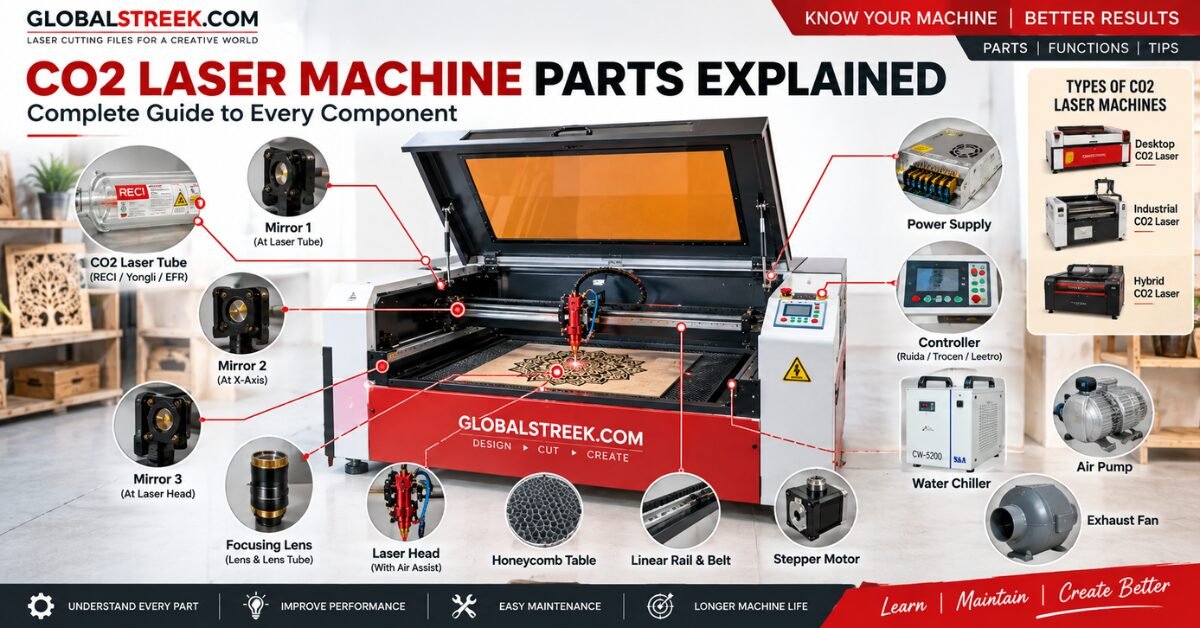
A CO2 laser cutting machine may look simple from the outside, but several mechanical, electrical, optical, electronic, cooling, and safety components work together inside it. Each part has a specific job, and the machine needs all of these systems to work together for accurate cutting and engraving.
Whether you plan to build a new CO2 laser machine, repair an existing one, replace a component, or simply learn how the machine works, understanding its main parts is important.
In this guide, we will explain the major CO2 laser machine parts, what each component does, why it matters, and how these components work together to create a complete laser cutting system.
1. Machine Frame
The machine frame forms the foundation of the entire CO2 laser cutting machine.
Manufacturers mount almost every major component to the frame, including the laser tube, guide rails, motors, working table, electrical cabinet, and motion system.
A strong steel or aluminum frame helps reduce vibration and keeps the machine stable during operation. A weak or poorly aligned frame can cause unwanted movement, alignment problems, and inaccurate cutting.
For this reason, the frame plays an important role in the overall stability and accuracy of the machine.
2. Working Table
The working table supports the material during cutting and engraving.
CO2 laser machines commonly use two types of cutting tables:
Honeycomb Table
A honeycomb table works well for paper, leather, fabric, acrylic, and other thin materials. Its open structure allows air and smoke to move through the material area more easily.
Blade Table
A blade or knife table works well for thicker materials such as MDF, plywood, and wood sheets. The gaps between the blades allow smoke and debris to move away from the cutting area while reducing unwanted contact between the material and the table.
Some machines also use a motorized Z-axis table that moves up and down. This feature helps the operator adjust the working height for different materials and accessories.
3. CO2 Laser Tube
The CO2 laser tube is the primary laser source in a traditional CO2 laser cutting machine.
It generates the infrared laser beam that the machine uses for cutting and engraving.
A typical glass CO2 laser tube contains a sealed gas mixture that includes:
- Carbon dioxide (CO₂)
- Nitrogen (N₂)
- Helium (He)
The electrical discharge inside the tube excites the gas mixture and produces laser radiation.
CO2 laser tubes come in different power ratings, such as 40W, 60W, 80W, 100W, 130W, and 150W. Higher-power tubes can generally provide more cutting capacity and may allow faster processing, although actual cutting performance also depends on the material, optics, focus, air assist, machine design, and settings.
4. Laser Power Supply (LPSU)
The laser power supply, often called the LPSU, provides the high voltage required to operate the CO2 laser tube.
The tube cannot run directly from the normal low-voltage output of a household electrical supply. The laser power supply converts and regulates the electrical input to provide the voltage and current required by the tube.
The controller sends firing commands to the power supply, and the power supply controls the laser tube accordingly.
A reliable and properly matched power supply helps provide stable laser operation. The power supply must match the specifications of the laser tube and the machine’s electrical system.
5. Mirror Set
Most traditional CO2 laser cutting machines use a three-mirror optical system to guide the laser beam from the fixed laser tube to the moving laser head.
The mirrors redirect the beam along the required path.
A typical arrangement uses:
- Mirror 1: Redirects the beam from the laser tube.
- Mirror 2: Changes the beam direction toward the laser head.
- Mirror 3: Directs the beam downward toward the focusing lens.
CO2 laser mirrors use highly reflective coatings designed for the laser’s infrared wavelength.
Correct mirror alignment is essential. Poor alignment can cause the beam to miss the center of the lens, reduce cutting performance, and create inconsistent results across the working area.
6. Focusing Lens
The focusing lens concentrates the laser beam into a small focal spot on the material.
After the beam travels through the mirror system, it enters the focusing lens inside the laser head. The lens concentrates the beam so that the machine can deliver a high energy density to a precise point.
Different focal lengths suit different applications. A shorter focal length can provide a smaller focal spot and detailed engraving, while a longer focal length can provide a greater depth of focus for some cutting applications.
The lens must remain clean and undamaged. Smoke, dust, residue, or scratches on the lens can reduce laser performance and may cause excessive heating or damage.
7. Laser Head
The laser head holds and positions important optical and air-assist components near the cutting area.
Depending on the machine design, the laser head may contain:
- Focusing lens
- Lens holder
- Nozzle
- Air assist connection
- Lens protection components
- Autofocus components
The laser head directs the focused beam toward the material and delivers air assist around the cutting point.
Some modern CO2 laser machines also use an automatic focusing system, which can make setup faster and help maintain the correct focus distance.
8. Air Assist System
The air assist system directs a controlled stream of air through the nozzle toward the point where the laser meets the material.
It performs several important functions during cutting, including:
- Removing smoke and debris from the cutting area
- Reducing excessive burning
- Helping produce cleaner cut edges
- Reducing residue around the cutting point
- Helping protect the focusing lens from smoke and particles
- Reducing the chance of small flames
Air-assist pressure depends on the material, thickness, nozzle design, and cutting settings.
A clean and properly adjusted air-assist system can make a noticeable difference when cutting materials such as wood, MDF, and acrylic.
9. Air Compressor
The air compressor supplies compressed air to the air assist system.
Small CO2 laser machines may use compact diaphragm compressors, while larger machines may use higher-capacity oil-free compressors designed for longer operating periods.
The compressor should provide sufficient airflow and pressure for the laser head and the material being processed.
A regulator and moisture-management system can also help maintain a clean and consistent air supply.
10. Water Cooling System
A CO2 laser tube generates significant heat during operation, so it needs an effective cooling system.
The water cooling system circulates coolant through the laser tube and removes heat generated during operation.
Depending on the machine, the system may include:
- Water pump
- Water reservoir or tank
- Water tubing
- Flow protection
- Temperature monitoring
- Water chiller
Proper cooling helps maintain stable laser output and protects the tube from excessive heat.
Operating a water-cooled CO2 laser tube without adequate cooling can damage the tube and create serious machine problems.
11. Water Chiller
A water chiller provides controlled cooling for the laser tube.
Basic machines may use a water pump and reservoir, while many higher-power or production machines use a dedicated chiller.
The chiller removes heat from the circulating water and maintains the coolant within the temperature range specified by the laser tube manufacturer.
Stable coolant temperature becomes especially important during long production runs because excessive temperature changes can affect tube performance and lifespan.
12. Motion System
The motion system moves the laser head across the working area.
A typical CO2 laser motion system may include:
- Linear guide rails
- Timing belts
- Belt pulleys
- Bearings
- Carriages
- Motor mounts
- Drive components
The motion system must move smoothly and accurately. Any excessive play, loose belt, damaged bearing, or misaligned rail can affect cutting accuracy and engraving quality.
Regular inspection and proper maintenance help keep the motion system running smoothly.
13. Stepper Motors or Servo Motors
Motors provide the movement required to position the laser head along the X and Y axes.
Stepper Motors
Stepper motors are common in entry-level and mid-range CO2 laser machines. They move in controlled steps based on electrical pulses from the motor driver.
They offer a relatively simple and cost-effective motion solution for many laser machines.
Servo Motors
Industrial machines may use servo motors when the application requires higher speed, precise positioning, and feedback from the motor system.
Servo systems can monitor motor position and correct movement based on feedback, depending on the system design.
The choice between stepper and servo motors depends on the machine’s design, required speed, accuracy, workload, and cost.
14. Motor Drivers
Motor drivers connect the controller to the machine’s motors.
The controller sends movement commands, and the motor drivers convert those commands into the electrical signals required to operate the motors.
A motor driver controls factors such as motor movement and current according to its design and configuration.
A properly matched driver helps the motors move smoothly and accurately.
15. Controller Board
The controller board acts as the central control system of the CO2 laser machine.
It receives the job instructions and coordinates the machine’s movement and laser operation.
Depending on the controller model, it may manage:
- Laser firing
- X-axis movement
- Y-axis movement
- Cutting speed
- Engraving speed
- Acceleration and deceleration
- Homing
- Limit switches
- Job sequence
- File storage
- Job preview
- Pause and resume functions
Popular CO2 laser controller brands include Ruida, Trocen, TopWisdom, and Leetro.
The controller also affects which software and file-transfer methods the machine can use, so compatibility matters when replacing or upgrading a controller.
16. Limit Switches
Limit switches provide reference points for the machine’s movement system.
When the operator starts a homing sequence, the machine moves the relevant axis toward its reference switch. Once the switch activates, the controller can establish the machine’s known position.
Limit switches can also help prevent the machine from traveling beyond its intended movement range, depending on the machine’s control configuration.
Correctly positioned and functioning limit switches are important for repeatable positioning and safe machine operation.
17. Control Panel
The control panel allows the operator to interact with the laser machine without controlling every function from a computer.
Depending on the controller and machine model, the panel may include:
- LCD display
- Touchscreen
- Navigation buttons
- Start button
- Pause button
- Stop button
- Job controls
- Emergency stop button
Many CO2 laser controllers also allow the operator to load or transfer files through USB, Ethernet, or other supported connections.
The exact features depend on the controller installed in the machine.
18. Electrical Cabinet
The electrical cabinet contains and protects many of the machine’s electrical components.
It may contain:
- Controller board
- Laser power supply
- Motor drivers
- Relays
- Circuit breakers
- Contactors
- Wiring terminals
- Cooling fans
- Power distribution components
Good electrical organization makes troubleshooting and maintenance easier.
The cabinet should remain clean, dry, and adequately ventilated. Operators should also inspect wiring and connections regularly for signs of overheating, looseness, or damage.
Because CO2 laser machines contain high-voltage components, electrical servicing should only be performed by someone with the appropriate knowledge and safety precautions.
19. Exhaust System
Laser cutting and engraving can produce smoke, fumes, odors, and airborne particles. The exhaust system removes these contaminants from the machine’s enclosure and directs them to an appropriate ventilation or filtration system.
A typical exhaust system includes:
- Exhaust fan
- Exhaust duct
- Machine exhaust outlet
- External ventilation outlet or filtration unit
A properly designed exhaust system improves visibility inside the machine and helps reduce the accumulation of smoke and fumes.
The exhaust setup should match the machine size and the materials being processed. Some applications may require additional fume filtration rather than simple exhaust to the outside.
20. Cable Chain
A cable chain, also known as an energy chain, organizes cables and air tubes connected to moving components.
As the laser head moves, the cable chain guides these cables along a controlled path.
It helps:
- Prevent cables from becoming tangled
- Reduce excessive bending
- Protect wires from rubbing against moving parts
- Keep the work area organized
- Extend cable service life
A damaged or poorly routed cable chain can cause unnecessary stress on wires and air tubing.
21. Emergency Stop Button
The emergency stop button provides a quick way to stop machine operation during an unsafe situation.
A properly designed emergency-stop circuit can stop hazardous machine functions when the operator presses the button.
The emergency stop should remain easily accessible and clearly identified.
It should not replace other safety features such as protective enclosures, interlock switches, proper grounding, and safe operating procedures.
22. Wiring and Connectors
A CO2 laser machine contains many electrical wires and connectors that link the controller, motors, sensors, power supplies, switches, and other components.
Common connections include:
- High-voltage laser cable
- Motor wiring
- Limit-switch cables
- Sensor wiring
- Power cables
- Grounding connections
- Communication cables
- Cooling-system wiring
Proper cable routing and secure connections improve reliability and make troubleshooting easier.
High-voltage wiring requires particular attention because CO2 laser power supplies can generate dangerous voltages. Never inspect or modify high-voltage components while the machine remains connected to power.
Optional CO2 Laser Machine Accessories
Many CO2 laser machines can use additional accessories that improve productivity or expand their capabilities.
Common options include:
- Rotary attachment for cylindrical objects
- Red dot pointer for positioning
- Autofocus system for automatic focusing
- CCD camera system for precise positioning and print-and-cut applications
- Wi-Fi or Ethernet connectivity for job transfer
- Air pressure regulator for controlling air assist
- Fume filtration unit for applications that require additional air treatment
- Honeycomb and blade table combination
- LED work light
- Motorized Z-axis table
Not every machine needs all of these accessories. The right combination depends on the materials, production requirements, and type of work.
Complete CO2 Laser Machine Parts Checklist
A typical CO2 laser cutting machine may include the following components:
- Machine frame
- Working table
- CO2 laser tube
- Laser power supply
- Mirror set
- Focusing lens
- Laser head
- Air assist nozzle
- Air compressor
- Water cooling system
- Water pump or water chiller
- X-axis assembly
- Y-axis assembly
- Linear guide rails
- Timing belts
- Belt pulleys
- Bearings
- Stepper or servo motors
- Motor drivers
- Controller board
- Control panel
- Limit switches
- Electrical cabinet
- Exhaust fan
- Exhaust duct
- Cable chain
- Emergency stop button
- Main power switch
- Wiring and connectors
Depending on the machine, additional components such as autofocus sensors, rotary attachments, red dot pointers, camera systems, temperature sensors, water-flow protection, and other safety devices may also be present.
How Do All CO2 Laser Machine Parts Work Together?
A CO2 laser cutting machine works as one integrated system. Each component performs a different task, but the final cutting result depends on how well these components work together.
The basic process looks like this:
Design → Software → Controller → Motion System → Laser Generation → Mirrors → Focusing Lens → Material
At the same time, several supporting systems operate alongside this process:
Cooling System + Air Assist + Exhaust System + Safety System
For example, the controller tells the motors where to move and tells the laser system when to fire. The mirrors guide the beam, the lens focuses it, and the air-assist system directs air toward the cutting point. Meanwhile, the cooling system manages the laser tube temperature and the exhaust system removes smoke and fumes.
This coordination allows the machine to cut and engrave complex designs accurately.
Conclusion
A CO2 laser cutting machine is much more than a laser tube mounted inside a metal frame. It is a complete system that combines laser technology, optics, mechanical movement, electronics, cooling, air assist, exhaust, software, and safety components.
The frame provides stability, the motion system moves the laser head, the laser tube generates the beam, the mirrors guide it, and the focusing lens concentrates it onto the material. At the same time, the controller coordinates movement and laser firing while the cooling, air-assist, exhaust, and safety systems support the cutting process.
Understanding CO2 laser machine parts and their functions makes machine operation, maintenance, troubleshooting, and upgrades much easier.
Whether you are building a new machine, repairing an existing CO2 laser, or planning an upgrade, choosing compatible components and installing them correctly can have a major effect on cutting accuracy, machine reliability, productivity, and component life.
Frequently Asked Questions
1. Which is the most important part of a CO2 laser machine?
The CO2 laser tube is the main laser source because it generates the laser beam. However, the machine also depends on the power supply, controller, optics, motion system, cooling system, and other components to operate correctly.
2. Can I build a CO2 laser machine from individual parts?
Yes, you can build a CO2 laser machine from individual components if you have the required mechanical, electrical, optical, and software knowledge. You must ensure that all components are compatible and that you follow appropriate electrical and laser safety practices.
3. Why do most CO2 laser machines use three mirrors?
Three mirrors provide a practical way to guide the laser beam from a fixed laser tube to the moving laser head. The mirrors redirect the beam along the optical path while allowing the laser head to move across the working area.
4. What does a water chiller do in a CO2 laser machine?
A water chiller removes heat from the cooling water and helps maintain a stable coolant temperature. This helps the laser tube operate within its specified temperature range during cutting and engraving.
5. Do all CO2 laser machines need an air compressor?
Machines that use air assist need a suitable source of compressed air. The air assist helps remove smoke and debris, reduces excessive burning, and can improve cutting quality.
6. What does the controller board do?
The controller receives machine instructions and coordinates functions such as laser firing, motor movement, speed, acceleration, homing, and job execution.
7. What is the purpose of the focusing lens?
The focusing lens concentrates the laser beam into a small focal spot on the material. Correct focusing allows the machine to deliver high energy density to the cutting or engraving point.
8. Why is mirror alignment important?
Correct mirror alignment ensures that the laser beam follows the intended optical path and enters the focusing assembly correctly. Poor alignment can reduce cutting performance and cause inconsistent results across the working area.
9. What is the purpose of the exhaust system?
The exhaust system removes smoke, fumes, odors, and airborne particles generated during laser cutting and engraving. A properly designed system helps maintain a cleaner working environment and better visibility inside the machine.
10. What are the main parts of a CO2 laser cutting machine?
The main components typically include the machine frame, working table, CO2 laser tube, laser power supply, mirrors, focusing lens, laser head, air assist, compressor, cooling system, motion system, motors, motor drivers, controller, limit switches, electrical cabinet, exhaust system, cable chain, and safety components